top of page


_edited.jpg)


Humans
To see an uncropped view of an artwork, click on it.

Wedding portrait: Taya & Bailey (2026)
Acrylic paint on wood, 28" diameter.
Created as a gift.
Created as a gift.

Detail

Detail

Detail

Detail

The happy couple! (2026)

Bridal shower portrait for Taya & Bailey (2026)
Acrylic paint on wood, 8" diameter.
Created as a gift.
Created as a gift.

Bridal shower portrait: detail (2026)
Acrylic on wood.
Created as a gift.
Created as a gift.

Wax models from Museo di Palazzo Poggi, Bologna, Italy (2026)
Pencil on paper.
In the collection of the artist.
About this drawing:
These flayed men are part of the Anatomical and Obstetrics Collection at the Museo di Palazzo Poggi. They were created by Ercole Lelli (1702-1766), the same artist who carved the wooden flayed men for the Anatomical Theatre (6 pages forward). The wax models were commissioned by Pope Benedict XIV. Besides these four men, his commission also included two nude figures and two skeletons (female and male, called “Eve” and “Adam”). The wax sculptures were built on a base of real human bones collected from dozens of cadavers, which were then wired together in poses similar to classical marble statues of the same period. From left to right, the sculptures reveal muscular anatomy from superficial to deep, stripping away the human body’s layers to reveal its inner workings.
(Stolze, 2013)
In the collection of the artist.
About this drawing:
These flayed men are part of the Anatomical and Obstetrics Collection at the Museo di Palazzo Poggi. They were created by Ercole Lelli (1702-1766), the same artist who carved the wooden flayed men for the Anatomical Theatre (6 pages forward). The wax models were commissioned by Pope Benedict XIV. Besides these four men, his commission also included two nude figures and two skeletons (female and male, called “Eve” and “Adam”). The wax sculptures were built on a base of real human bones collected from dozens of cadavers, which were then wired together in poses similar to classical marble statues of the same period. From left to right, the sculptures reveal muscular anatomy from superficial to deep, stripping away the human body’s layers to reveal its inner workings.
(Stolze, 2013)

Wax model from La Specola Anatomical Collection, Florence, Italy (2026)
Pencil on paper.
In the collection of the artist.
About this drawing:
The wax model in this drawing is a full-body cadaver, with 3D arteries tracing gracefully along its surface. It rests on comfortable-looking sheets and pillows in a large glass case. If the viewer were to crouch on the right side of the case, they would see that its eyes and mouth are slightly open, in a peaceful expression. The eyes are coloured in such a way that they appear alive, rather than dead. Several other glass cases nearby display nude female wax cadavers, also appearing relaxed with open, “alive” eyes and languid expressions. They touch their perfectly styled hair, or their blushed and blemish-free skin, in sensual poses. Some of them are even wearing pearls. Depicting female cadavers in this idealized, almost sexualized manner was so common among Italian anatomical waxwork that this type of sculpture came to be known as an Anatomical Venus (Ballestriero, 2010). These sculptures capture a feeling of beauty and ecstasy in agony (Ballestriero, 2010), akin to Roman Catholic representations of martyrs and saints. (Note: Although the face of the model in this drawing appears alive and peaceful, it is not an example of an Anatomical Venus.)
Italian anatomical wax sculptures typically depict their subjects as “alive”, graceful, and even attractive. The artists were careful to omit the more grisly realities of a cadaver, so as to facilitate learning by avoiding hesitancy and repulsion. In contrast, anatomical waxes from Northern regions such as the UK, the Netherlands and Germany are usually more realistic, almost brutal, sparing no detail of a real cadaver. They lie on minimalist wooden blocks, death grimaces frozen in rigor mortis. Their skin is wrinkled and mottled with bruises and blood. These sculptures are much more disturbing to look at than their Italian counterparts. The sculptors have made no attempt to coddle the uninitiated viewer.
(Ballestriero, 2010)
In the collection of the artist.
About this drawing:
The wax model in this drawing is a full-body cadaver, with 3D arteries tracing gracefully along its surface. It rests on comfortable-looking sheets and pillows in a large glass case. If the viewer were to crouch on the right side of the case, they would see that its eyes and mouth are slightly open, in a peaceful expression. The eyes are coloured in such a way that they appear alive, rather than dead. Several other glass cases nearby display nude female wax cadavers, also appearing relaxed with open, “alive” eyes and languid expressions. They touch their perfectly styled hair, or their blushed and blemish-free skin, in sensual poses. Some of them are even wearing pearls. Depicting female cadavers in this idealized, almost sexualized manner was so common among Italian anatomical waxwork that this type of sculpture came to be known as an Anatomical Venus (Ballestriero, 2010). These sculptures capture a feeling of beauty and ecstasy in agony (Ballestriero, 2010), akin to Roman Catholic representations of martyrs and saints. (Note: Although the face of the model in this drawing appears alive and peaceful, it is not an example of an Anatomical Venus.)
Italian anatomical wax sculptures typically depict their subjects as “alive”, graceful, and even attractive. The artists were careful to omit the more grisly realities of a cadaver, so as to facilitate learning by avoiding hesitancy and repulsion. In contrast, anatomical waxes from Northern regions such as the UK, the Netherlands and Germany are usually more realistic, almost brutal, sparing no detail of a real cadaver. They lie on minimalist wooden blocks, death grimaces frozen in rigor mortis. Their skin is wrinkled and mottled with bruises and blood. These sculptures are much more disturbing to look at than their Italian counterparts. The sculptors have made no attempt to coddle the uninitiated viewer.
(Ballestriero, 2010)

Wax model from Collezione delle Cere Anatomiche, Bologna, Italy (2026)
Pencil on paper.
In the collection of the artist.
About this drawing:
This drawing is of a wax model I saw in the Luigi Cattaneo Anatomical Wax Collection. The museum features many intricate models of pathological and normal anatomy, which were made in the 19th century by Giuseppe Astorri, Cesare Bettini, and other Italian artists (Official Bologna Tourist Information Website, n.d.-a).
Wax modelling in Italy reached its zenith during the 18th century, and soon spread to other European countries, where prestigious schools were then created to teach this art form. The techniques used to create wax models were kept largely secret, but modern CT scan research has been carried on out wax models that reveal their internal structure (Pastor et al., 2015).
[Continued on next page.]
In the collection of the artist.
About this drawing:
This drawing is of a wax model I saw in the Luigi Cattaneo Anatomical Wax Collection. The museum features many intricate models of pathological and normal anatomy, which were made in the 19th century by Giuseppe Astorri, Cesare Bettini, and other Italian artists (Official Bologna Tourist Information Website, n.d.-a).
Wax modelling in Italy reached its zenith during the 18th century, and soon spread to other European countries, where prestigious schools were then created to teach this art form. The techniques used to create wax models were kept largely secret, but modern CT scan research has been carried on out wax models that reveal their internal structure (Pastor et al., 2015).
[Continued on next page.]

Wax model from Collezione delle Cere Anatomiche, Bologna, Italy (2026)
Pencil on paper.
In the collection of the artist.
About this drawing:
[Continued from previous page]
These CT scan studies revealed that sculptural composition varied by region: for example, wax-soaked cloths moulded onto real bones in Bologna, versus plaster-moulded figures reinforced by wood in Florence. In all countries and regions, organic items such as teeth and hair were commonly used, and sometimes real human skulls. The incorporation of human bones was more common in wax models representing joints or deep regions, rather than models representing superficial regions.
(Pastor et al., 2015).
Metals and silicates were also found in some models, which researchers believe indicates the use of an injection-corrosion technique. The artist would inject a mixture of wax and cinnabar (a red metal compound) into a select region of a cadaver’s blood vessels. The vessel walls would corrode and the wax would solidify, and then would be removed from the cadaver. This highly accurate cast would be added to a wax sculpture.
(Pastor et al., 2015).
Leonardo da Vinci was the first person to inject solid material into a cadaver to create anatomical models. He injected wax into the ventricular cavities of the brain and the cardiac cavities. Later artists adapted his technique for other body regions.
(Pastor et al., 2015).
In the collection of the artist.
About this drawing:
[Continued from previous page]
These CT scan studies revealed that sculptural composition varied by region: for example, wax-soaked cloths moulded onto real bones in Bologna, versus plaster-moulded figures reinforced by wood in Florence. In all countries and regions, organic items such as teeth and hair were commonly used, and sometimes real human skulls. The incorporation of human bones was more common in wax models representing joints or deep regions, rather than models representing superficial regions.
(Pastor et al., 2015).
Metals and silicates were also found in some models, which researchers believe indicates the use of an injection-corrosion technique. The artist would inject a mixture of wax and cinnabar (a red metal compound) into a select region of a cadaver’s blood vessels. The vessel walls would corrode and the wax would solidify, and then would be removed from the cadaver. This highly accurate cast would be added to a wax sculpture.
(Pastor et al., 2015).
Leonardo da Vinci was the first person to inject solid material into a cadaver to create anatomical models. He injected wax into the ventricular cavities of the brain and the cardiac cavities. Later artists adapted his technique for other body regions.
(Pastor et al., 2015).

Portable pharmacy kit from Museo Storico Nazionale Dell’arte Sanitaria, Rome, Italy (2026)
Pencil on paper.
In the collection of the artist.
About this drawing:
In English, this museum’s name is “National Historical Museum of Sanitary Art”. It is housed in a former anatomical theatre, in Santo Spirito in Sassia, one of the oldest hospitals in Europe. It features a reconstruction of a 17th century pharmacy and chemical laboratory, a library of old books, and many anatomical models and artifacts. Sadly, this incredible museum is poorly known and many people find it tricky to get in due to unclear opening hours and uncontactable staff. Our class is lucky to have seen it!
(Kandiss, 2019; Marras, 2020)
The Sala Capparoni (“Capparoni Hall”) in this museum houses many ancient medical tools, biological artifacts, and portable pharmacies from the 17th to 19th centuries (like this one!) Portable pharmacies are small wooden trunks which would fit comfortably into one or two palms. Unlocking the pharmacy with a key would reveal drawers, doors, and small compartments. These would be filled with small bottles, boxes, and envelopes, containing various preparations and substances used in first aid and the treatment of disease.
(Santo Spirito, n.d.; VirtualMuseum, n.d.)
In the collection of the artist.
About this drawing:
In English, this museum’s name is “National Historical Museum of Sanitary Art”. It is housed in a former anatomical theatre, in Santo Spirito in Sassia, one of the oldest hospitals in Europe. It features a reconstruction of a 17th century pharmacy and chemical laboratory, a library of old books, and many anatomical models and artifacts. Sadly, this incredible museum is poorly known and many people find it tricky to get in due to unclear opening hours and uncontactable staff. Our class is lucky to have seen it!
(Kandiss, 2019; Marras, 2020)
The Sala Capparoni (“Capparoni Hall”) in this museum houses many ancient medical tools, biological artifacts, and portable pharmacies from the 17th to 19th centuries (like this one!) Portable pharmacies are small wooden trunks which would fit comfortably into one or two palms. Unlocking the pharmacy with a key would reveal drawers, doors, and small compartments. These would be filled with small bottles, boxes, and envelopes, containing various preparations and substances used in first aid and the treatment of disease.
(Santo Spirito, n.d.; VirtualMuseum, n.d.)

Thoracic spine and ridcage from Museo Storico Nazionale Dell’arte Sanitaria, Rome, Italy (2026)
Pencil on paper.
In the collection of the artist.
About this drawing:
This artifact is located in the Flajani Hall, another room within the Museo Storico. This room houses the oldest collection in the museum, dating from the late 17th century. It features more than 40 anatomical wax models by Giovanni Battista Manfredini, as well as real human specimens with deformities. Some of these are preserved in glass jars filled with formalin, and others (mainly fetal skulls and small skeletons) are preserved dry on little platforms like this one.
(Marras, 2020)
This specimen particularly captivated me. I’m drawn to its shapes: the twisting, fluid movement of the object as a whole; the soft parallel curves of the ribs contrasted by the almost perfectly straight lower two ribs; the spine like a mountain range.
The scientist and storyteller in me are also curious how this person came to have such a severe deformation, and I wonder about what their life was like (however brief it was). I investigated many historical and modern scientific resources, but was unable to find answers that could plausibly identify or explain this condition.
In the collection of the artist.
About this drawing:
This artifact is located in the Flajani Hall, another room within the Museo Storico. This room houses the oldest collection in the museum, dating from the late 17th century. It features more than 40 anatomical wax models by Giovanni Battista Manfredini, as well as real human specimens with deformities. Some of these are preserved in glass jars filled with formalin, and others (mainly fetal skulls and small skeletons) are preserved dry on little platforms like this one.
(Marras, 2020)
This specimen particularly captivated me. I’m drawn to its shapes: the twisting, fluid movement of the object as a whole; the soft parallel curves of the ribs contrasted by the almost perfectly straight lower two ribs; the spine like a mountain range.
The scientist and storyteller in me are also curious how this person came to have such a severe deformation, and I wonder about what their life was like (however brief it was). I investigated many historical and modern scientific resources, but was unable to find answers that could plausibly identify or explain this condition.

Archiginnasio Anatomical Theatre, Bologna, Italy (2026)
Pencil on paper.
In the collection of the artist.
About this drawing: Designed by architect Antonio Morandi and built in the late 16th century, the Palazzo dell’Archiginnasio was the seat of the University of Bologna until 1803. The Anatomical Theatre shown here is on the upper floor. It was created by Antonio Levante in 1637 for anatomical teaching. Dissections were performed on the stone table at the centre of the room.
(Official Bologna Tourist Information Website, n.d.-b).
On the ceiling of the Theatre there is an intricate wooden sculpture of Apollo, the god of medicine, surrounded by figures representing the constellations. These were all installed in the middle of the 17th century. Also around this time, two stunning wooden sculptures carved by Ercole Lelli were installed at the front of the room. These appear four times in this drawing. They are called the Spellati (the “skinned ones”.)
(Conservare Valore Nel Tempo, n.d.).
The Anatomical Theatre has had much reconstructive work, especially following World War II. The restorationists worked with salvaged rubble, so that their work would not only look identical to the originals, but would also consist of the same material. This preserves the integrity of the original space. (Conservare Valore Nel Tempo, n.d.).
In the collection of the artist.
About this drawing: Designed by architect Antonio Morandi and built in the late 16th century, the Palazzo dell’Archiginnasio was the seat of the University of Bologna until 1803. The Anatomical Theatre shown here is on the upper floor. It was created by Antonio Levante in 1637 for anatomical teaching. Dissections were performed on the stone table at the centre of the room.
(Official Bologna Tourist Information Website, n.d.-b).
On the ceiling of the Theatre there is an intricate wooden sculpture of Apollo, the god of medicine, surrounded by figures representing the constellations. These were all installed in the middle of the 17th century. Also around this time, two stunning wooden sculptures carved by Ercole Lelli were installed at the front of the room. These appear four times in this drawing. They are called the Spellati (the “skinned ones”.)
(Conservare Valore Nel Tempo, n.d.).
The Anatomical Theatre has had much reconstructive work, especially following World War II. The restorationists worked with salvaged rubble, so that their work would not only look identical to the originals, but would also consist of the same material. This preserves the integrity of the original space. (Conservare Valore Nel Tempo, n.d.).

Sketch: Fountain of Neptune, Bologna, Italy (2026)
Pencil on paper.
In the collection of the artist.
In the collection of the artist.

Charlotte & Henry (2025)
Acrylic paint & coloured pencil on paper.
Given away as a gift.
Given away as a gift.

Ash & Paris (2025)
Ink & acrylic paint on paper.
Given away as a gift.
Given away as a gift.

Eyeball jeans (2024)
Bleach on denim.
In the collection of the artist.
In the collection of the artist.

Dandelion & Crocus (2024)
Ink on paper.
Given away as a gift.
Given away as a gift.

Eyeball jeans (2024)

Eyeball jeans (2024)

Sketch: Eliza in a box
(2024)
Pen on paper.
In the collection of the artist.
In the collection of the artist.

Eliza & Kevin (2024)
Mixed media on paper.
Given away as a gift.
Given away as a gift.

Eliza (2023)
Pencil on paper.
Given away as a gift.
Given away as a gift.
Murals
To see an uncropped view of an artwork, click on it.

Heart in my Hands (2026)
Commissioned by the Calgary Telus Convention Centre
Medium: Exterior latex wall paint
---
About this piece:
This mural explores what it feels like for me to be an LGBTQ+ person in Alberta.
It is a courageous and vulnerable thing to share your truest self with others. Being an openly LGBTQ+ person often feels like holding your beating heart in your hands and hoping the world will be gentle with it.
At the same time, there is so much power and beauty in who we are. This is represented by the heart glowing from within, and the Albertan plants growing from it. (Yarrow, the Wild Rose, Gumweed, clover, and prairie grass.) These plants also represent how natural it is to be an LGBTQ+ person. We belong to these prairies as much as any other Albertan.
Nature is highly variable and rarely binary. LGBTQ+ identities are simply part of being human. As a nonbinary person, my gender is also related to my spirituality, and my connection to the earth and its nonhuman creatures.
Like the rest of the natural world, we cannot force ourselves to be something that we are not. We thrive when we live in alignment with who we were meant to be.
Medium: Exterior latex wall paint
---
About this piece:
This mural explores what it feels like for me to be an LGBTQ+ person in Alberta.
It is a courageous and vulnerable thing to share your truest self with others. Being an openly LGBTQ+ person often feels like holding your beating heart in your hands and hoping the world will be gentle with it.
At the same time, there is so much power and beauty in who we are. This is represented by the heart glowing from within, and the Albertan plants growing from it. (Yarrow, the Wild Rose, Gumweed, clover, and prairie grass.) These plants also represent how natural it is to be an LGBTQ+ person. We belong to these prairies as much as any other Albertan.
Nature is highly variable and rarely binary. LGBTQ+ identities are simply part of being human. As a nonbinary person, my gender is also related to my spirituality, and my connection to the earth and its nonhuman creatures.
Like the rest of the natural world, we cannot force ourselves to be something that we are not. We thrive when we live in alignment with who we were meant to be.

Heart in my Hands (2026)
Video by Cameron Sullivan

Process
Photo by Cameron Sullivan

Process
Photo by Cameron Sullivan

Process
Photo by Cameron Sullivan

Process
Photo by Cameron Sullivan

Process
End of day 3! :)

Alcove Window Case Mural (2026)
Commissioned by Alcove Centre for the Arts
Medium: Acrylic paint
Size: 17'2" by 4'4"
Medium: Acrylic paint
Size: 17'2" by 4'4"

Street view of Alcove, showing Window Case Mural (2026) & Entranceway Pillar (2025)

Alcove entranceway pillar (2025), South face
Commissioned by Alcove Centre for the Arts
Medium: Exterior latex wall paint
Medium: Exterior latex wall paint

West face

North face

East face

Detail

Detail

Detail

Detail

Detail

Interview: Alcove Community Mural (2025)
During February- May 2025 I facilitated a collaborative community mural at the Alcove Centre for the Arts, and painted the pillar outside Alcove's front entrance.
Interview by Bethel Afework (@bethel02 on instagram).
Video by Kyle Wilson (@kyle1382 on instagram).
Interview by Bethel Afework (@bethel02 on instagram).
Video by Kyle Wilson (@kyle1382 on instagram).

Alcove Community Mural (2025)
Commissioned by Alcove Centre for the Arts
Medium: Interior wall paint
Medium: Interior wall paint

Process
Community collaboration!
Location & Photo credit: Alcove Centre for the Arts
Location & Photo credit: Alcove Centre for the Arts

Process
Location & Photo credit: Alcove Centre for the Arts

Process
Location & Photo credit: Alcove Centre for the Arts

Artist talk: Alcove Community Mural (2025)
Artist talk/interview & community paint night at midpoint of project.
Location & Photo credit: Alcove Centre for the Arts
Location & Photo credit: Alcove Centre for the Arts

Process
Location & Photo credit: Alcove Centre for the Arts
Plants & Animals
To see an uncropped view of an artwork, click on it.

Star tattoos: Left & right shoulder (2025)
Digital.
In the collection of the artist.
In the collection of the artist.
Alcove Community Mural (2025)
Latex paint.
Commissioned work.
Commissioned work.

Lizard (2024)
Bleach on t-shirt.
In the collection of the artist.
In the collection of the artist.

Lizard (2024)

My lil lizard's face, 2 years of heavy wear later

Messengers of Spring (2024)
Mixed media.
In the collection of the Teeny Tiny Art Collective.
Photographs by Jordan King. (@iamthejordanking on Instagram)
In the collection of the Teeny Tiny Art Collective.
Photographs by Jordan King. (@iamthejordanking on Instagram)

Details: Messengers of Spring (2024)
Photos by Jordan King. (@iamthejordanking on Instagram)

Terracotta Fishbowl (2024)
Acrylic paint on terracotta pot.
In the collection of the artist.
In the collection of the artist.

Feather tattoo: left hip (2024)
Digital.
In the collection of the artist.
In the collection of the artist.

Fern tattoo: right hip (2024)
Digital.
In the collection of the artist.
In the collection of the artist.

Eliza & Kevin (2024)
Mixed media on paper.
Given away as a gift.
Given away as a gift.

Sunflower tattoo for Taya (2023)
Digital.
Commissioned work.
Tattooed without yellow circle.
Commissioned work.
Tattooed without yellow circle.

Wisdom speaker (Bird mask) (2023)
Mixed media on papier mache.
In the collection of the artist.
Similar custom masks are available upon request- just contact me!
Photos by Garrett Hykawy
In the collection of the artist.
Similar custom masks are available upon request- just contact me!
Photos by Garrett Hykawy

Wisdom speaker (Bird mask) (2023)

Wisdom speaker (Bird mask) (2023)

Wisdom speaker (Bird mask) (2023)

Wisdom speaker (Bird mask) (2023)

Leaf earrings (2023)
Given away as a gift.
The beads are on a wire which is woven through the leaf. The leaf is coated in resin for strength.
The beads are on a wire which is woven through the leaf. The leaf is coated in resin for strength.

Sketch: Eliza & Calf (2023)
Pen & highlighter on paper.
Given away as a gift.
Given away as a gift.

My bee tattoo: full right thigh (2022)
Digital.
In the collection of the artist.
In the collection of the artist.

Detail: my bee tattoo (2022)

Two-headed cat (2022)
Pencil on paper.
In the collection of the artist.
In the collection of the artist.

6 of Wands (tarot card) (2022)
Digital. In the collection of the artist.

Knight of Swords (tarot card) (2022)
Digital. In the collection of the artist.

Knight of Pentacles (tarot card) (2022)
Digital. In the collection of the artist.
Landscapes
To see an uncropped view of an artwork, click on it.

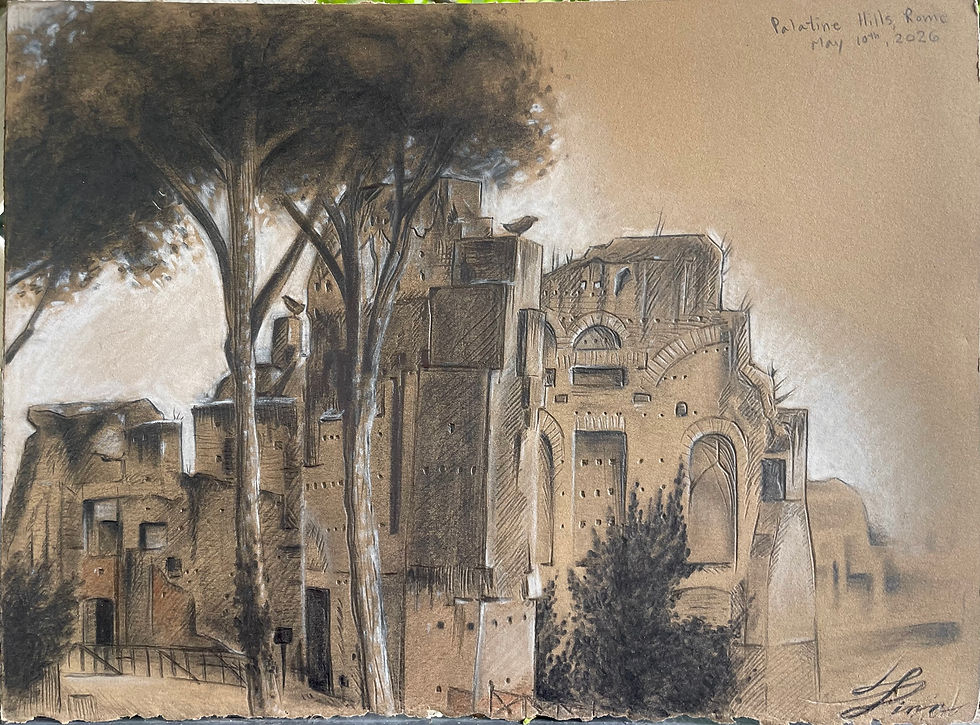
Palatine Hills, Rome, Italy (2026)
Pencil on paper.
Given away as a gift.
About this drawing:
In the second century CE, prominent Roman physician Galen frequented the Palatine libraries and a nearby warehouse (Nicholls, 2011). This particular building captured my attention, for its multi-tiered silhouette and the atmosphere of the surrounding area. I sat here drawing until it started to rain. Based on research after completing this drawing, this is likely the House of Augustus, the residence of the first emperor of Rome (Frederica, n.d.).
Given away as a gift.
About this drawing:
In the second century CE, prominent Roman physician Galen frequented the Palatine libraries and a nearby warehouse (Nicholls, 2011). This particular building captured my attention, for its multi-tiered silhouette and the atmosphere of the surrounding area. I sat here drawing until it started to rain. Based on research after completing this drawing, this is likely the House of Augustus, the residence of the first emperor of Rome (Frederica, n.d.).

Street views of Rome, Italy (2026)
Pencil on paper.
In the collection of the artist.
About this drawing:
One of my favourite things about Italy was seeing how ancient architecture has been incorporated into modern life. Graffiti on crumbling stone walls, apartments and grocery stores nestled beside wonders of the ancient world, cars inching down narrow cobblestone streets. Ordinary daily life, unchanging human nature, extraordinary architecture. I wanted to highlight that symbiosis in these drawings, and capture how these places actually feel to exist in, instead of cropping those details out to achieve the “perfect” photo. On the left, the focal point is the apartment buildings and the electrical towers on top of them. The Pantheon is a backdrop to this snapshot of daily life. On the right (a live drawing of a lecture), I was interested in the scaffolding and the aliveness of the open square.
In the collection of the artist.
About this drawing:
One of my favourite things about Italy was seeing how ancient architecture has been incorporated into modern life. Graffiti on crumbling stone walls, apartments and grocery stores nestled beside wonders of the ancient world, cars inching down narrow cobblestone streets. Ordinary daily life, unchanging human nature, extraordinary architecture. I wanted to highlight that symbiosis in these drawings, and capture how these places actually feel to exist in, instead of cropping those details out to achieve the “perfect” photo. On the left, the focal point is the apartment buildings and the electrical towers on top of them. The Pantheon is a backdrop to this snapshot of daily life. On the right (a live drawing of a lecture), I was interested in the scaffolding and the aliveness of the open square.
Archiginnasio Anatomical Theatre, Bologna, Italy (2026)
Pencil on paper.
In the collection of the artist.
About this drawing:
Designed by architect Antonio Morandi and built in the late 16th century, the Palazzo dell’Archiginnasio was the seat of the University of Bologna until 1803. The Anatomical Theatre shown here is on the upper floor. It was created by Antonio Levante in 1637 for anatomical teaching. Dissections were performed on the stone table at the centre of the room.
(Official Bologna Tourist Information Website, n.d.-b).
On the ceiling of the Theatre there is an intricate wooden sculpture of Apollo, the god of medicine, surrounded by figures representing the constellations. These were all installed in the middle of the 17th century. Also around this time, two stunning wooden sculptures carved by Ercole Lelli were installed at the front of the room. These appear four times in this drawing. They are called the Spellati (the “skinned ones”.)
(Conservare Valore Nel Tempo, n.d.).
The Anatomical Theatre has had much reconstructive work, especially following World War II. The restorationists worked with salvaged rubble, so that their work would not only look identical to the originals, but would also consist of the same material. This preserves the integrity of the original space. (Conservare Valore Nel Tempo, n.d.).
In the collection of the artist.
About this drawing:
Designed by architect Antonio Morandi and built in the late 16th century, the Palazzo dell’Archiginnasio was the seat of the University of Bologna until 1803. The Anatomical Theatre shown here is on the upper floor. It was created by Antonio Levante in 1637 for anatomical teaching. Dissections were performed on the stone table at the centre of the room.
(Official Bologna Tourist Information Website, n.d.-b).
On the ceiling of the Theatre there is an intricate wooden sculpture of Apollo, the god of medicine, surrounded by figures representing the constellations. These were all installed in the middle of the 17th century. Also around this time, two stunning wooden sculptures carved by Ercole Lelli were installed at the front of the room. These appear four times in this drawing. They are called the Spellati (the “skinned ones”.)
(Conservare Valore Nel Tempo, n.d.).
The Anatomical Theatre has had much reconstructive work, especially following World War II. The restorationists worked with salvaged rubble, so that their work would not only look identical to the originals, but would also consist of the same material. This preserves the integrity of the original space. (Conservare Valore Nel Tempo, n.d.).

Basilica of Saint Mary of Minerva, Rome, Italy (2026)
Pencil on paper.
Given away as a gift.
About this drawing:
The Basilica of Saint Mary of Minerva was constructed from 1453 to 1725, through collaboration between many architects, artists, and religious leaders (Santa Maria sopra Minerva, n.d.). This basilica is built in a gothic architectural style, which is characterized by cavernous spaces and tall structures intended to draw the eye towards Heaven (Britannica, 2026). I wanted to capture the repeating nested archway shapes that extend in multiple planes of direction. The effect that these create is rather dizzying. The perspective I used for this piece is meant to convey the feeling of physically being in the basilica and looking up at it all.
Given away as a gift.
About this drawing:
The Basilica of Saint Mary of Minerva was constructed from 1453 to 1725, through collaboration between many architects, artists, and religious leaders (Santa Maria sopra Minerva, n.d.). This basilica is built in a gothic architectural style, which is characterized by cavernous spaces and tall structures intended to draw the eye towards Heaven (Britannica, 2026). I wanted to capture the repeating nested archway shapes that extend in multiple planes of direction. The effect that these create is rather dizzying. The perspective I used for this piece is meant to convey the feeling of physically being in the basilica and looking up at it all.

River House Mural (2025)
Acrylic paint and interior latex paint.
This was my first mural and I taught myself the whole process :)
This was my first mural and I taught myself the whole process :)

Detail- River House Mural (2025)

Detail- River House Mural (2025)

Messengers of Spring (2024)
Mixed media .
In the collection of the Teeny Tiny Art Collective.
Photographs by Jordan King.
In the collection of the Teeny Tiny Art Collective.
Photographs by Jordan King.

Details- Messengers of Spring (2024)
Photographs by Jordan King.

Streetlight (2022)
Acrylic paint on canvas.
In the collection of the artist.
In the collection of the artist.

Cornwall Cliffs (2020)
Acrylic paint on canvas.
In the collection of the artist.
In the collection of the artist.
bottom of page